.png)
If Christianity Is True and You Still Say “No,” That Reveals Everything
- dktippit3
- Mar 4
- 4 min read

A lot of people think the biggest hurdle to Christianity is information.
“What about the manuscripts?” “What about contradictions?” “What about science?” “What about other religions?”
Those are real questions. Some of them are important, but every once in a while, someone says something so honest, so unfiltered, that it cuts straight past the fog and exposes what’s really going on.
Here’s one of those moments:
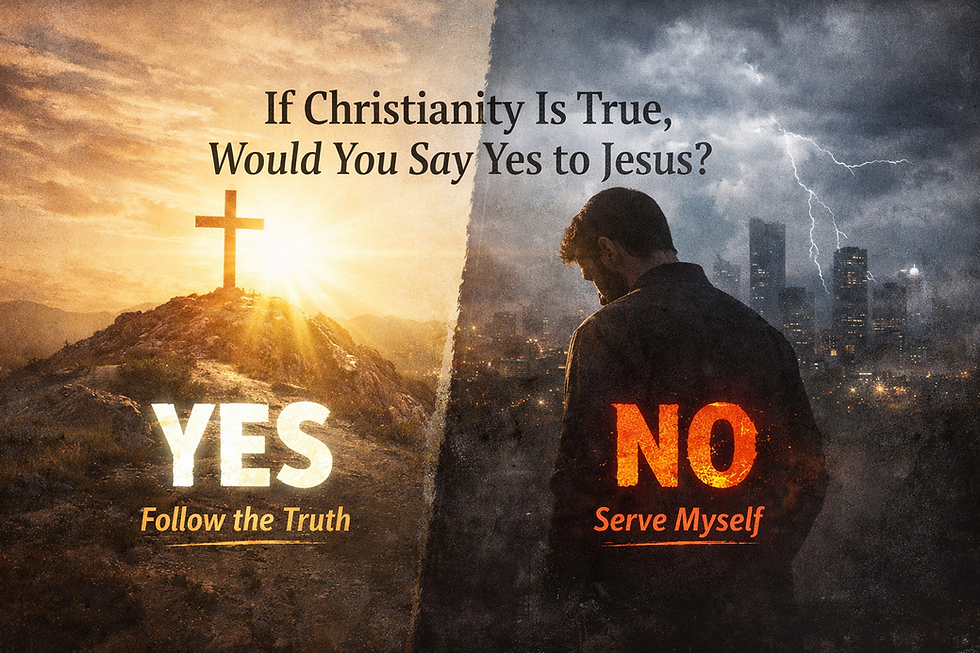
Me: “Answer this question for me. If Christianity is true, would you say yes to Jesus?”
The other person: “No.”
That answer reveals more about a person’s heart than a thousand debates ever could.
The Most Revealing Answer
Notice what just happened. This person didn’t say, “I’m not convinced it’s true.” They didn’t say, “I need more evidence.” They didn’t say, “I have questions I can’t reconcile.”
They said something else entirely: Even if it’s true, I still don’t want Him.
That’s not an intellectual objection. That’s a spiritual position.
It’s the difference between “I can’t” and “I won’t.” And those are worlds apart.
Why That “No” Matters
When someone says, “If it’s true, I still wouldn’t follow Jesus,” they’re accidentally confessing something most people keep hidden: This isn’t mainly about facts. It’s about authority.
Because Christianity, if true, isn’t merely a comforting worldview or a moral philosophy. Christianity is a claim that a living King has rightful authority over your life, your body, your money, your desires, your relationships, your future, your identity.
To say “no” to Jesus, even if He’s real, is to say:
“I don’t want anyone to tell me what I am.”
“I don’t want anyone to tell me what I’m for.”
“I don’t want to submit.”
“I want autonomy more than truth.”
And that’s why this answer is so clarifying. It doesn’t hide behind questions. It doesn’t pretend to be neutral. It’s blunt: I prefer myself to God even if God is a known fact.
Now Reverse the Question
Here’s the part most people don’t think about. If the question was reversed on me, “If it were a fact that God does not exist, would you still say yes to Jesus?”, my answer would have to be no.
Why?
Because if I’m truly seeking truth, then truth has to be lived out. There is no other way to live. If I claim to be a truth-seeker but refuse to live according to what is true, I’m not a truth-seeker at all, I’m a self-seeker.
Otherwise, I’m choosing to live a lie. And choosing to live a lie is not only selfish, because it’s saying “my comfort matters more than reality”, but it’s also intellectual suicide. It’s the death of honesty. It’s the decision to abandon reason the moment reason becomes inconvenient.
The Modern Myth of “Neutral”
We live in a time where people act like unbelief is the default setting, as if everyone is “neutral” until they’re convinced. But no one is neutral about authority.
People aren’t just weighing evidence like a robot. We’re not brains in jars. We’re moral creatures. We love. We fear. We desire. We resist. We protect what we worship.
And here’s what Jesus does: He doesn’t just ask you to agree with Him. He asks you to follow Him. That’s why some people would rather Christianity be false. Because if it’s true, it changes everything.
Why This Was Always the Main Issue
This is not new. Jesus dealt with this exact dynamic constantly.
Some people watched Him perform miracles and still didn’t believe. Not because they lacked data, but because they didn’t want what His presence required.
Jesus said people avoid the light because the light exposes them.
If you can keep Christianity in the category of “interesting discussion,” you can stay in charge. But if Christianity is true, then Jesus is not a topic, He’s Lord. And that’s the moment the heart gets tested.
What This Means for Christians
First, don’t be shocked.
If someone tells you “no,” you’ve just been given clarity. Now you know how to pray. You know where the conversation actually is. You know it’s not merely a matter of apologetic answers. It’s a matter of surrender.
Second, don’t become arrogant. That answer should humble us, not puff us up. Because apart from grace, that “no” lives in every human heart. We’re not Christians because we’re smarter. We’re Christians because God was merciful.
Third, don’t stop loving them. A “no” is not the end of the story. It’s a snapshot of where someone is right now. God can soften hard hearts. He’s been doing it for a long time.
in the end
When someone says, “No, even if Christianity is true,” they’ve revealed the core issue: Not a lack of evidence. Not unanswered questions. Not intellectual difficulty. But a refusal of authority.
And that answer, more than anything they could ever say or do, exposes what they worship most:
Self as king.
Which is exactly why Jesus doesn’t just offer information.
He offers rescue.
And He still invites: “Come, follow Me.”


Comments