.png)
While We Complain They Are Dying
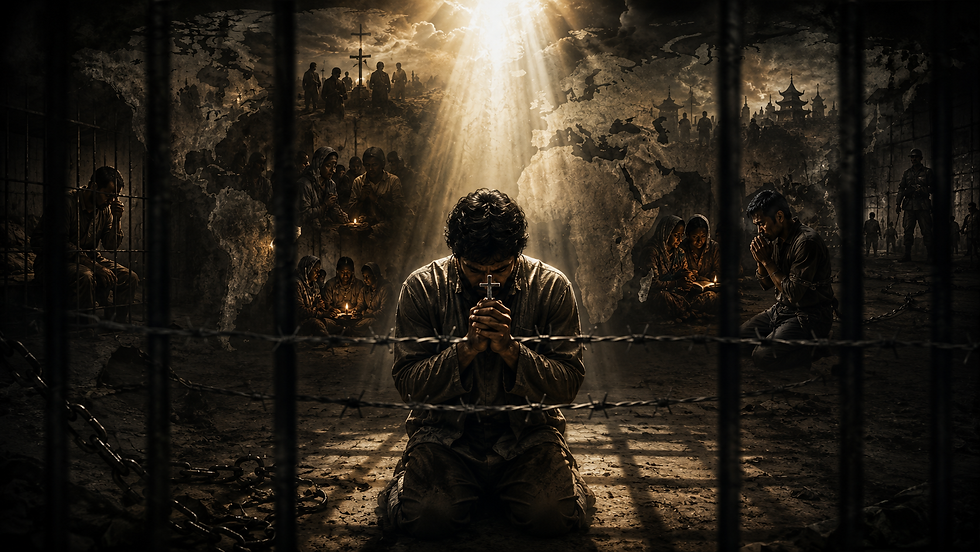
There is a kind of language we have grown comfortable with in the American church.
Someone rolls their eyes at our beliefs, and we call it persecution. Someone mocks biblical morality online, and we call it suffering. Someone says Christians are narrow-minded, outdated, or intolerant, and we act as though we are bearing the full weight of the cross.
To be fair, hostility is hostility. Ridicule is real. Social pressure is real. Losing opportunities because you refuse to bow to the spirit of the age is real. Jesus never told us to dismiss that. But we also need perspective.
Because while many Christians in the United States are upset over being disliked, many Christians around the world are being hunted, imprisoned, tortured, sexually assaulted, abducted, and killed for the name of Jesus Christ.
That is not an exaggeration. That is the present reality of the global Church.
According to Open Doors’ 2026 reporting, more than 388 million Christians worldwide face high levels of persecution and discrimination for their faith. In the top 50 worst countries alone, 315 million Christians face very high or extreme persecution. During the latest reporting period, Open Doors documented 4,849 Christians killed, 4,712 detained, arrested, sentenced, or imprisoned, 3,302 abducted, 3,632 churches or Christian properties attacked, and 5,202 Christians raped, sexually harassed, or forced into marriage because of their faith.
Let that sink in.
This is not a fringe issue. This is not a few isolated stories. This is one of the defining realities of the Church in our time.
The worst places to follow Christ
Open Doors’ World Watch List 2026 names the top ten worst countries for Christian persecution as North Korea, Somalia, Yemen, Sudan, Eritrea, Syria, Nigeria, Pakistan, Libya, and Iran.
North Korea remains the darkest example. Open Doors estimates that 50,000 to 70,000 Christians are imprisoned there in labor camps and detention facilities, and many were arrested simply for owning a Bible, worshiping secretly, or having contact with other Christians. Open Doors also estimates there are about 400,000 secret believers still in the country.
In Nigeria, the crisis often looks less like mass imprisonment and more like relentless bloodshed. Open Doors reports that 3,490 of the 4,849 Christians killed worldwide during the latest reporting period were killed in Nigeria alone.
In Yemen, recent reporting described an “unprecedented crackdown” in which more than 50 Christians were arrested, with reports of interrogation, imprisonment, and possible torture.
In Pakistan, Christians continue to live under the threat of blasphemy accusations and mob violence. USCIRF reported that a mob lynched Nasir Masih, a 70-year-old Christian man, after accusing him of desecrating a Qur’an.
In Eritrea, detainees have described being held in metal shipping containers, underground barracks, and other brutal facilities, while suffering torture, extreme temperatures, and denial of medical treatment. USCIRF’s 2026 reporting says authorities have coerced detainees to renounce their faith and banned praying aloud, singing, preaching, and possessing religious books.
So yes, Christians in America may face pressure. But many of our brothers and sisters face something else entirely. They are not just being criticized. They are being crushed.
This should humble us
The point is not to minimize every hardship believers in the West face. The point is to correct our proportions.
We have grown so used to comfort that inconvenience feels like persecution. We have grown so used to cultural influence that losing approval feels like martyrdom. We have grown so used to ease that even minor opposition can seem unbearable.
Meanwhile, believers elsewhere are meeting underground because discovery could cost them their children, their freedom, or their lives. Some are worshiping in whispers. Some are hiding pages of Scripture. Some are sitting in cells. Some are being beaten. Some are being forced into marriages. Some are disappearing. Some are dying with the name of Jesus on their lips.
That should not just make us emotional. It should make us honest.
None of this surprises the Bible
Scripture never promised the Church safety in this age.
Jesus said plainly, “If the world hates you, know that it has hated Me before it hated you” (John 15:18). He told His disciples, “If they persecuted Me, they will also persecute you” (John 15:20). He warned that a time was coming when people would kill believers and think they were offering service to God (John 16:2). He said, “Then they will deliver you up to tribulation and put you to death, and you will be hated by all nations for My name’s sake” (Matthew 24:9).
Paul did not soften it either: “Indeed, all who desire to live a godly life in Christ Jesus will be persecuted” (2 Timothy 3:12).
Peter told suffering believers not to act shocked: “Beloved, do not be surprised at the fiery trial when it comes upon you to test you” (1 Peter 4:12). And Revelation shows the souls of martyrs crying out before God from under the altar (Revelation 6:9–11).
In other words, the persecution of Christians is not a strange interruption in the Christian story. It is part of the Christian story.
The Church follows a crucified Messiah. We should never expect the world to applaud the people who bear His name.
The pattern began long before the Church
This also tracks with the larger biblical pattern.
God’s covenant people have always been opposed. Israel was chosen by God, and the nations raged. Pharaoh tried to break them. Assyria came for them. Babylon crushed Jerusalem. The prophets were rejected. The righteous suffered. Then, when the fullness of time had come, the Messiah Himself arrived—and was hated, betrayed, falsely accused, mocked, scourged, and crucified.
The suffering did not stop with Christ. It intensified around all who belonged to Him.
That makes sense biblically. Christianity is not a detached religion that appeared from nowhere. It is the fulfillment of what God promised through Israel, the Law, the Prophets, and the Messiah. Jesus did not come to abolish but to fulfill (Matthew 5:17). The New Testament does not erase the Old Testament story; it brings it to its climax in Christ.
And through Christ, the covenant promises of blessing are opened to the nations. Gentiles are not saved apart from Israel’s story but brought into it through Israel’s Messiah. Paul says Gentile believers are grafted in (Romans 11:17–24), that in Christ the dividing wall is broken down (Ephesians 2:11–22), and that those who belong to Christ are Abraham’s offspring by faith (Galatians 3:26–29).
So the hatred is not random. The line of attack runs through the whole biblical story: God’s people, God’s promises, God’s Messiah, and all who belong to Him.
Why the hatred is ultimately spiritual
The Bible is clear that our struggle is not merely against flesh and blood, but against rulers, authorities, and spiritual forces of evil (Ephesians 6:12).
That means persecution is not only political. It is spiritual.
Behind prison cells, blasphemy laws, terror groups, mob violence, church bombings, and state crackdowns stands a deeper hatred. Satan has always opposed the purposes of God. He opposed God’s people in the Old Testament. He moved against the promised line. He raged against Christ. And he now rages against Christ’s Church.
First John speaks of the spirit of antichrist already being in the world (1 John 4:3). Revelation 12 describes the dragon making war on the woman and then on “those who keep the commandments of God and hold to the testimony of Jesus” (Revelation 12:17). Revelation 13 shows the beast being allowed to make war on the saints (Revelation 13:7).
From a biblical and theological standpoint, this is why the hatred seems so relentless. Satan does not merely hate generic religion. He hates the God of Israel, the covenant purposes of God, the Messiah, and everyone united to that Messiah by faith.
And yes, many Christians see Jerusalem as especially significant in that story because Scripture ties the city to God’s redemptive purposes and to the return and reign of Christ. At minimum, the Bible presents Jerusalem as central to God’s unfolding plan in both Testaments. So the rage surrounding that land and city should not surprise anyone who takes the Bible seriously.
But the hatred aimed at Christians today has a particular edge because Jesus has already come, died, risen, and triumphed. The demons recognized Him even during His earthly ministry (Mark 1:24; Luke 4:41). Satan knows exactly who Jesus is. He knows who was raised. He knows who will return. And he knows his end is the lake of fire (Revelation 20:10).
That is why persecution of Christians is not just hatred of morality, tradition, or religious identity. It is hatred of Christ.
The world is still trying to kill the witness
When a government imprisons Christians, it is trying to silence the Gospel.
When extremists kidnap believers, they are trying to terrify the Church.
When mobs burn churches, they are trying to erase Christian witness from public life.
When women and girls are assaulted or forced into marriage because they are Christians, evil is trying to shame and break the people of God.
When believers are executed, the world is trying to say: “Jesus is not worth this.”
But over and over again, the Church answers back with its blood: “He is.”
That is what makes persecuted Christians such a rebuke to a comfortable church. They remind us that Christianity is not a brand, not a voting bloc, not a vibe, not a social tribe, not a lifestyle accessory. It is allegiance to the living Christ—an allegiance worth suffering for, and if necessary, dying for.
What should Christians in the West do with this?
First, we should repent of our small categories.
We need to stop throwing the word persecution around so casually. Not because opposition is unreal, but because our brothers and sisters in prison cells deserve better than our self-centered exaggerations.
Second, we should remember the global Church.
The body of Christ is bigger than our county, our church network, our denomination, or our country. Hebrews 13:3 says, “Remember those who are in prison, as though in prison with them.” That is not sentimental language. That is a command.
Third, we should pray like this is real, because it is.
Pray for believers in North Korea, Somalia, Yemen, Sudan, Eritrea, Syria, Nigeria, Pakistan, Libya, Iran, and everywhere else Christ is costly. Pray for imprisoned pastors. Pray for secret church leaders. Pray for assaulted women. Pray for kidnapped children. Pray for boldness, endurance, provision, rescue, and faithfulness unto death.
Fourth, we should stop wasting our freedoms.
If we still have open Bibles, open churches, legal protections, public speech, and access to discipleship, then we should use them. We should teach better. Disciple deeper. Worship more boldly. Speak more clearly. Live more faithfully. Comfort has made much of the Western church lazy. The suffering church exposes that.
Finally, we should prepare our hearts.
Not by fear. By conviction.
The world is not becoming more friendly to Christ. The age is not drifting toward neutrality. Scripture never told us to expect that. It told us to endure, to stand, to watch, to remain faithful, and to overcome by the blood of the Lamb and the word of our testimony (Revelation 12:11).
While we complain, they’re dying
That title is sharp, but it is meant to be.
Because many of us do complain. We complain about being disliked, dismissed, or treated unfairly. And sometimes those things do hurt. But across the world, believers are paying far more than wounded feelings.
They are paying with their homes. Their bodies. Their children. Their freedom.Their lives.
And still they cling to Christ.
That should sober us. It should humble us. It should awaken us. The Church has not been abandoned. Christ has not lost control. None of this has caught heaven off guard. The hatred of the world, the rage of the enemy, the suffering of the saints, and the endurance of the Church all fit inside the story Scripture has already told.
The prophets suffered. Israel suffered. Christ suffered. The apostles suffered. The Church suffers.
But Jesus Christ is risen. He is reigning now. He will return. And one day, every prison, every camp, every execution ground, every burned church, every hidden grave, every silenced witness, and every drop of martyr’s blood will testify that He was worth it all.
So let us complain less. Pray more. Stand firmer. Love deeper. And remember the persecuted Church.
Because while many of us are busy defending our comfort, our brothers and sisters are dying with courage for the name of Jesus Christ.


Comments